

Most people do not struggle to get healthy because they do not know what they are supposed to do. They already know that eating better, moving regularly, getting enough sleep and taking care of their mental wellbeing are important. The real problem usually comes when they try to change too many things at the same time.
You decide that this is finally the week you are going to get serious about your health. You find a new diet, plan your workouts, cut out sugar, promise yourself that you will stop eating out, start drinking more water, buy a few supplements and decide that you are going to sleep earlier.
For the first few days, everything feels under control. You are motivated, organised and proud of yourself.
Then real life gets in the way.
Work becomes stressful, you sleep late, someone invites you out for dinner or you simply have a difficult day. You miss your workout or eat something that was not part of your plan, and suddenly you feel as though you have failed.
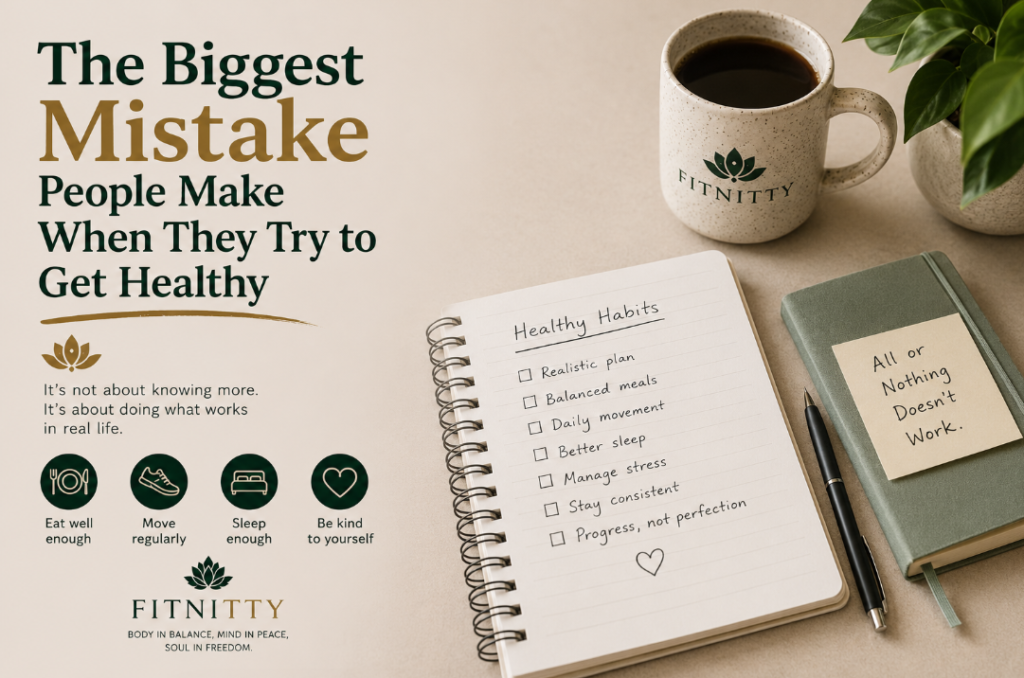
This is one of the biggest mistakes people make when they try to get healthy: they build their health around a perfect routine instead of building healthy habits that can fit into real life.
We often make healthy living harder than it needs to be
There is nothing wrong with wanting to make meaningful changes to your health. The problem is expecting yourself to make all of those changes perfectly from day one.
A new routine can feel exciting when you are motivated, but motivation is not going to look the same every day. There will be mornings when you feel energetic and ready to exercise, and there will be mornings when you have slept badly and are rushing to get to work.
There will be days when you have time to prepare a healthy meal, and there will be days when ordering dinner feels like the only realistic option.
That does not mean your healthy lifestyle has failed. It means you are living a normal life.
A healthy approach needs to account for that.
The all-or-nothing approach rarely works for long
One of the easiest traps to fall into is thinking that you are either doing everything right or you are doing nothing right.
You might eat very carefully throughout the week, avoid foods you enjoy and follow your plan exactly. Then you go out for dinner on Saturday, have dessert and perhaps eat more than you intended.
Instead of seeing that as one meal, you might think, “Well, I’ve already ruined my diet, so I’ll start again on Monday.”
That one thought can turn a normal weekend into several days of overeating, followed by another strict reset on Monday.
The cycle becomes exhausting because you are constantly moving between being extremely disciplined and feeling as though you have lost control.
The issue is not necessarily that you need more willpower. It may simply be that your approach is too restrictive to work with your actual life.
Your health routine has to work when life gets busy
Think about the healthiest routine you could follow on your best day. You might have plenty of time to cook, exercise, meditate, prepare your meals and get to bed early.
Now think about your busiest day of the week.
You have meetings all day, you get home late, you are tired and you have very little time or energy left.
Which version of your routine is more important?
The second one.
If your healthy habits only work when everything goes according to plan, they are not really helping you build a sustainable lifestyle.
This is why small, realistic changes can be much more useful than trying to completely redesign your life overnight. You might start by adding a proper source of protein to your breakfast, taking a walk after dinner, preparing a simple meal before a busy day or making your bedtime a little more consistent.
These changes may not feel dramatic, but they are much easier to repeat.
And repeated habits are what eventually create meaningful change.
Stop looking for the perfect diet
Another common mistake is believing that there must be a perfect diet somewhere that will finally make everything easy.
You try one approach, then another. Perhaps you count calories for a while, remove certain foods, follow a meal plan or try a popular diet you found online.
It works for a few weeks, but eventually it becomes difficult to maintain.
Then you assume you need a better diet.
Sometimes, what you actually need is a more realistic approach.
A healthy way of eating should provide enough nourishment and variety while also fitting your preferences, lifestyle and circumstances. It should not require you to avoid every food you enjoy or completely change the way you live.
There is room for flexibility.
There is room for eating out.
There is room for celebrations.
There is room for days when you do not follow your usual routine.
The goal is not to make those things disappear. The goal is to learn how to include them without feeling that you have undone all your progress.
Start with the basics before adding more
When people want to improve their health, it is easy to become distracted by the newest supplement, diet trend, workout programme or wellness hack.
Before adding more, it is worth asking whether the basics are already in place.
Are you eating enough nourishing food throughout the day? Are your meals satisfying? Are you getting enough protein and fibre? Are you eating a reasonable variety of foods? Are you moving your body regularly? Are you getting enough sleep?
These questions may not be as exciting as the latest health trend, but they are much more important.
You do not need to completely transform your lifestyle to start making progress. In many cases, the most useful changes are the ones that make your everyday routine a little healthier without making it feel impossible to maintain.
You do not need to start again every Monday
If you find yourself saying, “I’ll start again on Monday” every weekend, it may be worth looking at the plan rather than blaming yourself.
A healthy lifestyle should not feel like five days of restriction followed by two days of freedom.
It should be something that can move with you through different kinds of days.
Some weeks will go well. Other weeks will be messy. You may miss a few workouts, eat more than usual, sleep badly or spend several days away from your normal routine.
You do not need to wait for Monday to get back to your habits.
Your next meal is another opportunity to make a choice that supports you. Your next evening is another opportunity to go for a walk. Your next night is another opportunity to get some rest.
You can simply continue.
What should you do instead?
Rather than trying to change everything at once, choose one or two things that would make the biggest difference to your everyday life and start there.
If your meals are inconsistent, start by creating a simple meal routine. If you rarely move, start with a daily walk. If you are constantly tired, look at your sleep before adding another complicated wellness routine.
Give yourself enough time to make those habits feel normal before adding more.
The goal is not to create a routine that looks impressive on paper. The goal is to create a routine that you can still follow when you are busy, tired, travelling, socialising or simply having a difficult week.
That is the difference between a plan you can follow for a few weeks and a healthy lifestyle you can actually live with.
The Fitnitty takeaway
Getting healthy does not require you to become a completely different person.
You do not need to eat perfectly, exercise every day or follow a complicated routine to prove that you are serious about your health. What you need is an approach that fits your life well enough that you can keep coming back to it.
Instead of asking, “How can I become healthier as quickly as possible?” try asking, “What healthy habits can I realistically keep doing for years?”
That question can change the way you approach your health.
Because sustainable health is not built by being perfect for a week.
It is built by making better choices, adjusting when life changes and continuing even when things do not go perfectly.